

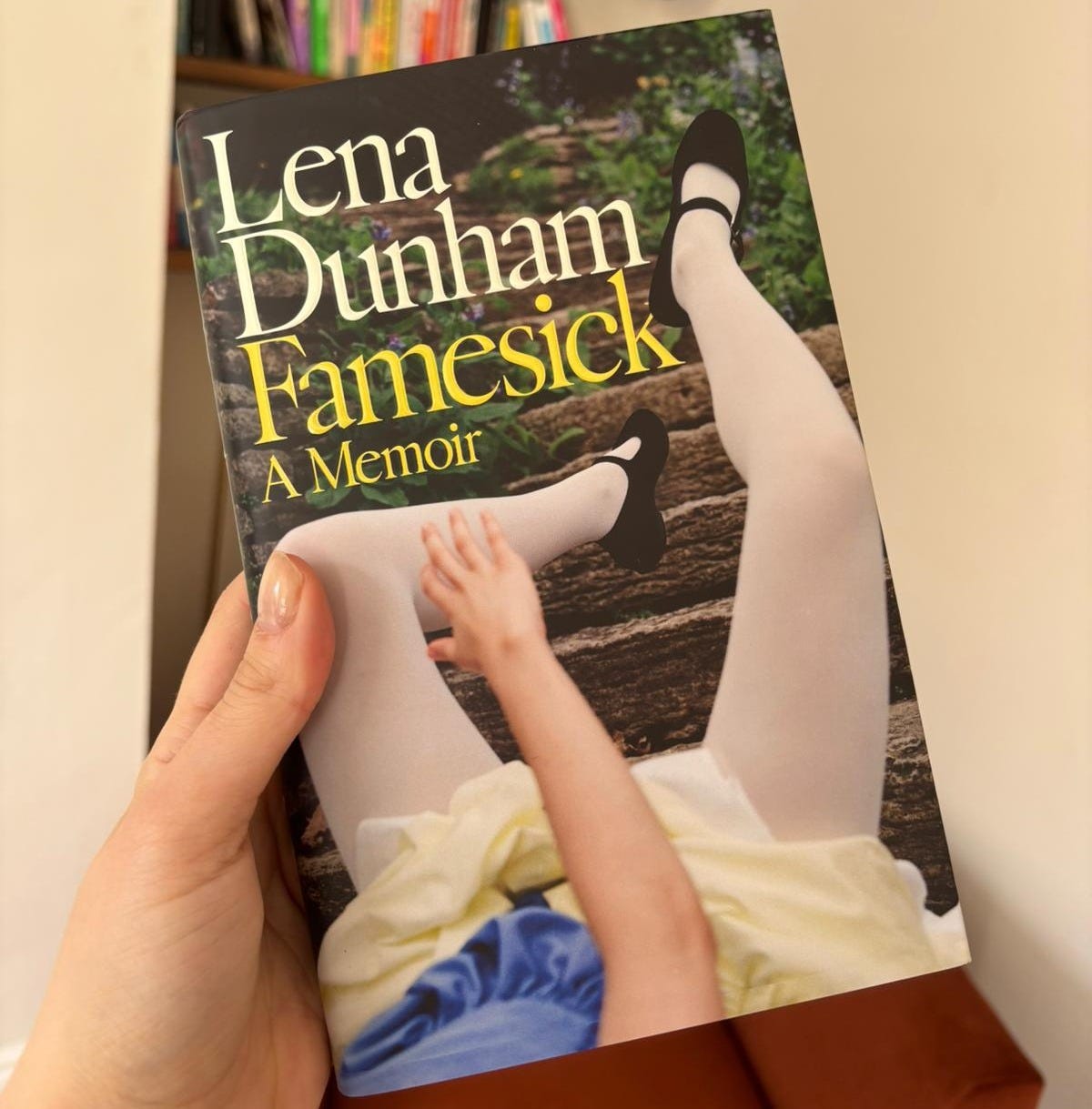
It is easy for journalists to write pompously about how celebrities should handle fame, safe in the knowledge that, as writers, we probably couldn’t become famous even if we tried. We’ll never know if fame would make us narcissists, whether we would be liked, whether we would get cancelled, or how we would write a public apology. There is an irony, too, to our often lofty detachment. Because as much as journalists may say we’re writing ‘to connect’ or to humbly make sense of our thoughts, of life, of culture, on the page, you cannot untangle the desire to be read from the desire to be known.
Dunham’s compulsive memoir Famesick is about her years of chronic pain suffering from endometriosis and Hypermobile Ehler Danlos Syndrome, misdiagnosed for years and ultimately incurable. Mirroring this is her fame, a secondary sickness that has proved just as unknowable and hard to shake, but elicits little sympathy, since people believe it is a privilege that she has brought it upon herself. Both feed off each other, exhausting Dunham and the people around her, who tire of the “the gelatinous way in which I took up space”.
I finished the book – both brilliant and frustrating – unsure of what to make of Dunham. She is a gifted, wonderfully funny writer, a fact I had somewhat forgotten in the years since GIRLS, when her output was mostly long-winded apology statements. But Famesick reminds you of her genius. The way she writes about GIRLS co-stars Jemima Kirke and Adam Driver are so evocative they seem to walk off the page: Kirke has “a mouth that threatened to overtake her face if she wasn’t careful” while Driver strode into his first audition “all ears and nose, gangly and pigeon-toed, lurching toward the audition chair like a reanimated corpse in a silent film”. The portraits of her mother and father are so vivid that I feel as if I could magic them into my flat, knowing how they would speak, what they might say. Even Dunham’s characterisation of her endearing but infuriating younger self makes you feel like you’re watching GIRLS all over again.
It is also impossible not to feel deeply moved by Dunham’s exhausting account of relentless pain, minimised by medical misogyny, eventually leading to a total hysterectomy, opiate addiction and rehab. It makes sense that, with no control over her uncooperative body, she would want to control her public narrative: the perception of her work, her values, of her spirit. This too, proved unwieldy, and so you get the sense that with this memoir, which has been seven years in the making, Dunham wants to nail down the definitive account of her life so far. To have the last word, and finally reconcile, as she writes, “my combative dynamic with my own public avatar”.
To some extent, her ambitions have been successful. I have read several pieces from journalists “apologising” to Dunham for contributing to the ever-burning petrol fire of Lena Dunham discourse. Broadly, the reviews of her memoir have been positive: there is no denying the woman can write. Yet arguably overshadowing the book’s artistic merit are the revelations that Adam Driver threw a chair at her, punched a hole through a wall or almost cheated on his now wife – allegations that are now all global newspaper headlines, which Dunham must surely have anticipated.
Magazines are also raking over the claims that Dunham’s ex-partner Jack Antonoff was likely having an affair with Lorde while producing her second album, and Dunham’s portrayal of GIRLS collaborator Jenni Konner, who presents as controlling and emotionally abusive. She bluntly tells her to gain weight for GIRLS or the show wouldn’t be funny, forcing Dunham to cap her pay to match hers and then dropping her when she got “too much”.
It was when Dunham arguably pins the worst controversy of her life onto Konner that I felt the book had its own manipulative streak. In 2017, Konner and Dunham, put out a statement defending Girls producer Murray Miller of sexual assault, just one month after Dunham wrote a MeToo themed op-ed in the New York Times. Dunham was accused of hypocrisy, and her apology in the Hollywood Reporter, deflecting via her own experiences of sexual assault and blaming internalised misogyny, was called tone deaf. In Famesick, she claims that she had spent days high on pain medication after having had her uterus removed, and doesn’t remember writing the statement. Konner comes across as the one in the driving seat, and, while Dunham remains apologetic and contrite, there is the sense, as is so often the case with Dunham, that it was all somebody else’s fault.
Throughout the book, Dunham presents as a naive ingenue, whose ultimate flaw is that she loves too much. During an explosive row with Antonoff near the end of their relationship, she claims he flushed her pain medication down the toilet after she told she might be addicted, prompting an emergency midnight visit to the hospital. She then writes:
“But all I knew in the moment was that—after years of small admissions, moments in which his doubt in my goodness and wholeness emerged—he had finally spoken to me in ways I had never been spoken to, never heard between my parents even as they battled and raged, never allowed, even when I was lying under the worst men, having the worst things happen. I thought at the time I was too tired to say them back—with hindsight, I realize I’m actually constitutionally incapable of it.’
Not only does that paragraph torch Antonoff in a way that somewhat undermines her claim that this memoir is “not a revenge memoir”, but she makes a moral distinction between herself and him. Antonoff has cruelty within him. Dunham, it seems, can only receive cruelty: from the women who one by one left a WhatsApp group after Dunham opened up about her infertility to the three ‘smug’ pregnant friends who said she was too incurious about their pregnancies while she was recovering from a hysterectomy. It is in these moments that I felt unsure whether Dunham is a victim or a narcissist; the truth is you can be both.
Dunham told the New York Times in this week’s Interview podcast that she has spent her entire life annoying people. She was an ‘annoying’ kid, she says, too ‘loud, try-hard’; that she has never known how to move through the world in a non-disruptive way. In the interview with David Marchese, you can hear, in a way that is both lovable and irritating, Dunham’s hope to be liked. She keeps saying Marchese’s first-name, flattering him, ribbing him, in what feels like an attempt to create a protective bubble of pseudo-intimacy.
It is difficult to extricate an opinion of Dunham uncoloured by the years of negative discourse that, as she rightly points out, felt disproportionate to her status. She was, as she tells Marchese, “just a TV writer”, with a show watched by less than a million people a week. She believes that her unapologetic sexuality on the show provoked an “intense rage about my body”, which not only came from male misogynists but women too. In the book she reveals that, after covering Vogue, “Jezebel—the feminist snark sis- ter of Gawker—put out a bounty on unretouched images of me. They framed it as a feminist issue—let’s prove that Vogue does not care about our fat sister!—but it felt only like the group of seventh-grade mean girls who had pointed out my water bra at the school dance, asking over and over if they could feel it.” Ironically, adds Dunham, Anna Wintour “has given me less grief than all the chubby women in Hollywood combined”.
I wonder if this is the last memoir Dunham will ever write. She is only 40, and so will continue, I hope, to create, which may inevitably involve some casualties. In a telling anecdote to the Guardian about her addictive personality, she compares a previous breakup to her relationship with the internet, which operates on a loop of break-ups and make-ups. She wanted to write him an email, and her dad said, “Well, why don’t you just ignore him? You’ve broken up, you don’t have to do anything else.” She replies: “Because I don’t want him to have the last word”. And then there they go again.
Things worth your time this week
The Drama, in cinemas
I’m not sure the film deserves the insatiable discourse about its controversial twist. I thought it was entertaining, funny, and provocative in a relatively un-challenging way. My entire cinema screening was laughing and mock-gasping the entire way through, because, really, wasn’t it just a rom-com after all?
Euphoria season three, NowTV
I am morbidly strapped in for this Sam Levinson horror show, despite giving the first three episodes just two stars in my review. Levinson, who writes alone, without a writer’s room, has trapped all four of his female leads into the practise or exploitation of sex work, and Zendaya’s Rue, written as Levinson’s own alter-ego and now working in a strip club, now functions as an extension of the male gaze. Making Sydney Sweeney’s Cassie an OnlyFans creator in a dog collar feels lazy (not to mention, in the scenes of her posing with a baby’s dummy, highly disturbing), and by episode three the constant slow-mo close-ups of Sweeney’s jiggling cleavage feels like trolling.
The great care home cash grab: how private equity turned vulnerable elderly people into human ATMs, Guardian
This excellent longread by Hettie O'Brien in last weekend’s Guardian Saturday magazine was horrifying: a 2021 US study found private equity takeovers increased nursing home resident deaths by an average of 11%. (It also reminded me of Rosamund Pike’s very good film I Care A Lot, about the exploitation of legal guardianship to drain elderly people’s assets.) Read the piece here.
Big pants: stop lecturing my about my post-partum body, Alice Vincent
A very good essay on Alice’s always thoughtful Substack Savour about the unhelpful pressure on women to love and celebrate their new bodies after giving birth. She writes: “We react, knee-jerkedly, when another woman decries her body after a major life change: ‘No, you’re not!’; ‘You don’t!’; ‘You look amazing!’. I can guarantee: it’s not making any of us feel better. What if we said something else? What if we said, ‘I’m sorry, it’s a raw deal’ or ‘it’s shit, isn’t it, when you don’t like how you look?’”. Read it here.
Plum Sykes and the return of the unpaid intern
Sophie Sajnani’s piece for her Substack Wilde Thoughts was particularly interesting to me, as someone whose entire career was made possible by several unpaid work experience weeks at Condé Nast UK, which were in turn made possible by the fact I was able to live at my family home in London, rent-free, financially supported by a few baby-sitting jobs and, ultimately, my parents. Journalism still has a privilege problem, and it’s alarming that Sykes has managed to convince the unpaid students working on her blog that she is doing them a favour, and that, as Sajnani notes, across Substack, unpaid jobs are the norm. Read the piece here.
Not read the book but heard all the big gossipy revelations hit the headlines this week and I think my thoughts align with yours. In Girls and the extracts from the book I've seen Dunham displays a scintillating self-awareness sometimes (emphasis on sometimes!) which was what made the show so raw and funny. I don't doubt that Hollywood is an evil place, but the fact that she is still friends with another talented woman with a huge victim complex, Taylor Swift, makes me inclined to doubt some of her narratives. It's also somewhat ironic that she says she hates the attention and yet has made all these suggestive claims about Adam Driver and Lorde that will follow them all around for years. But I guess it's kind of like the Meghan Markle situation: damned if you say something, or you feel like you damn yourself if you don't. Great article, appreciate the nuanced discussion.
We could just let her be.